 narrlitnarrlit
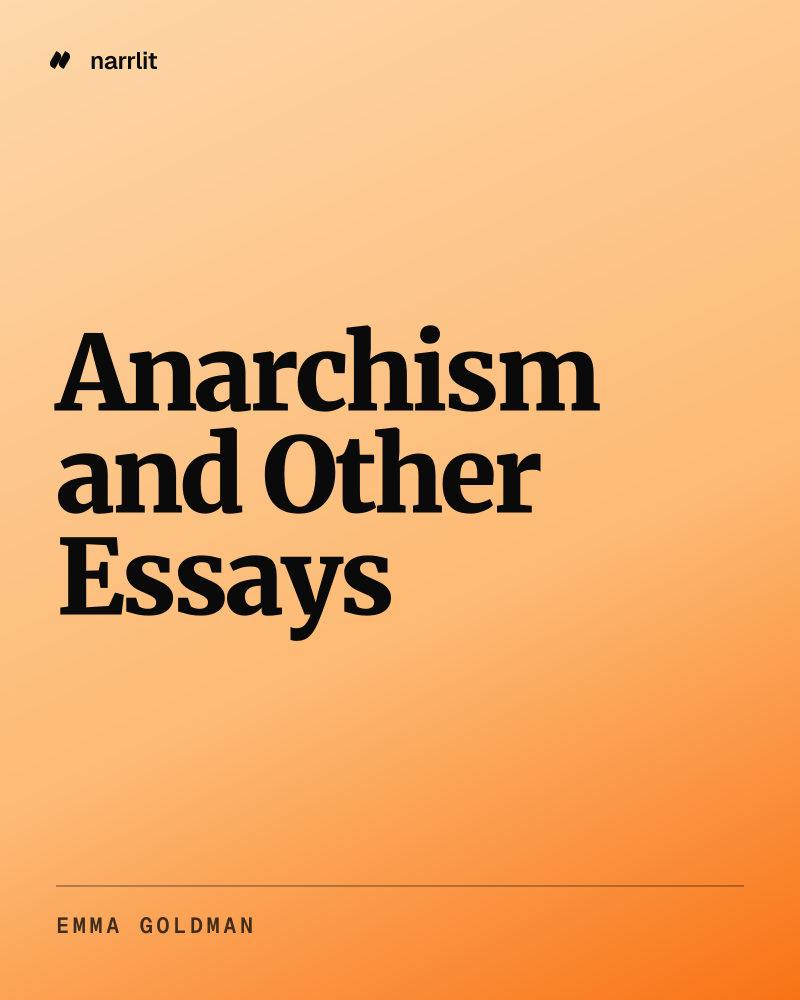
Emma Goldman · 45min
History’s most radical voice challenges the pillars of institutional control. These essays dissect political liberty, gender, and the suffocating grip of patriotism. Listen for a revolutionary vision.
“We selected Anarchism and Other Essays by Emma Goldman to explore its lasting influence on the evolution of philosophy. It provides a perfect canvas for debating the complex motives of its characters.”
Get this book free
Sign up and your first token is on us, use it to unlock permanently.
Emma Goldman’s Anarchism and Other Essays functions as a rigorous critique of the fundamental institutions governing modern life, structured as a series of thematic inquiries into the nature of authority. The text argues that the state, organized religion, and private property are not just unnecessary, but are active parasites on the human spirit. Goldman defines anarchism not as a descent into chaos, but as a new social order based on unrestricted liberty and the removal of man-made laws that serve primarily to protect the wealthy and punish the marginalized.
The essays systematically dismantle the pillars of societal respectability. Goldman critiques the American penal system as a self-sustaining cycle of recidivism that exploits convict labor for profit while failing to address the economic roots of crime. She challenges the concept of patriotism, characterizing it as a psychological manipulation used by the ruling class to justify military expansion and industrial exploitation. Most controversially, she opposes woman suffrage, arguing that the ballot is a distraction that would integrate women into a diseased political system rather than liberating them from deeper economic and domestic dependency.
The collection concludes by proposing education and art as the true vehicles for revolution. Goldman explains how the modern drama acts as a social agitator by bypassing intellectual defenses to expose injustices. While the book acknowledges the tragedy of political violence, it frames such acts as inevitable reactions to the unbearable pressure of institutional cruelty. Ultimately, the work resolves by envisioning organic solidarity—a future where human beings organize themselves voluntarily through shared interests and mutual aid rather than through state coercion.
Emma Goldman (1869–1940) was a Russian-born immigrant who became one of the most prominent radical voices in American history. Published in 1910, Anarchism and Other Essays represents the culmination of her years as a public speaker, organizer, and agitator. The book emerged during a period of intense labor volatility characterized by events like the Haymarket Affair and the Homestead Strike, where the American state frequently used lethal force against workers. Goldman wrote these essays at a time when industrial capitalism was rapidly expanding and the limits of political reform were being tested. Her work is rooted in the historical reality of the sweatshop and the prison cell, providing a theoretical framework for the disillusionment felt by the international working class. In this context, Goldman challenged not just specific laws, but the entire ideological foundation of the United States, arguing that economic and religious systems are as oppressive as any autocratic czar.
Goldman argues that acts of political violence are not the result of anarchist theory, but are tragic reactions to unbearable structural pressure. She uses the metaphor of a thunderstorm to explain that when social inequality and state repression become too heavy, a violent discharge is inevitable. A specific example in the text is her defense of the psychology behind individuals like Auguste Vaillant, who bombed the French Chamber of Deputies as a recoil against seeing mothers commit suicide because they could not afford bread.
For Goldman, external liberation is meaningless without internal emancipation from social tradition. She critiques the feminist movement for focusing solely on the right to vote, which she views as a distraction from deeper psychological freedom. She argues that a woman who works in a profession but still fears the judgment of a priest is not free. True emancipation requires the total rejection of internal tyrants—the inherited voices that demand respectability at the expense of individual autonomy and desire.
Goldman posits that the state manufactures the very criminality it claims to prevent. She notes that the vast majority of crimes are property violations driven by necessity. In her essay on prisons, she explains how capitalism denies workers the means of survival, pushing them toward theft. Instead of addressing the root cause, the state creates a slave labor operation where convicts work for the profit of private contractors, ensuring the marginalized remain trapped in a self-perpetuating cycle of punishment.
Moments from Jasper and Maya's discussion of Anarchism and Other Essays:
“We aren't just looking at, you know, a timeline of dates or reading a dry academic summary. We are stepping right into the crosshairs of the late nineteenth and early twentieth centuries.”
— Jasper
“The state is basically an apparatus of violence and the wealthy can always purchase their way out of that violence.”
— Maya
“Anarchism is the philosophy of a new social order based on liberty, unrestricted by man made law.”
— Maya
“You cannot achieve equality by participating in a system that is fundamentally diseased.”
— Jasper
“Love by its very nature is free. It cannot be bought, cannot be bound by a legal document, and it certainly cannot be enforced by a priest.”
— Maya
“She looked at a world that accepted poverty, war, and the subjugation of women as completely normal, and she screamed, no.”
— Jasper
It is a collection of radical philosophical essays that critique the state, private property, and religion as obstacles to human liberty. Goldman argues for a social order based on voluntary cooperation rather than institutional coercion or man-made laws.
The book was written by Emma Goldman, a Russian-born political activist and famous anarchist agitator. It was originally published in 1910, reflecting her experiences with the labor movements of the late 19th and early 20th centuries.
The discussion of Emma Goldman's work on this episode of narrlit is 45 minutes long. The hosts Jasper and Maya use this time to analyze the biographical context of her life and her specific critiques of marriage, patriotism, and the prison system.
The main themes include the failure of institutional reform, the internal emancipation of women from social tradition, and the role of art in social agitation. Goldman also focuses heavily on the psychological causes of political violence and the hypocrisy of the American penal system.