 narrlitnarrlit
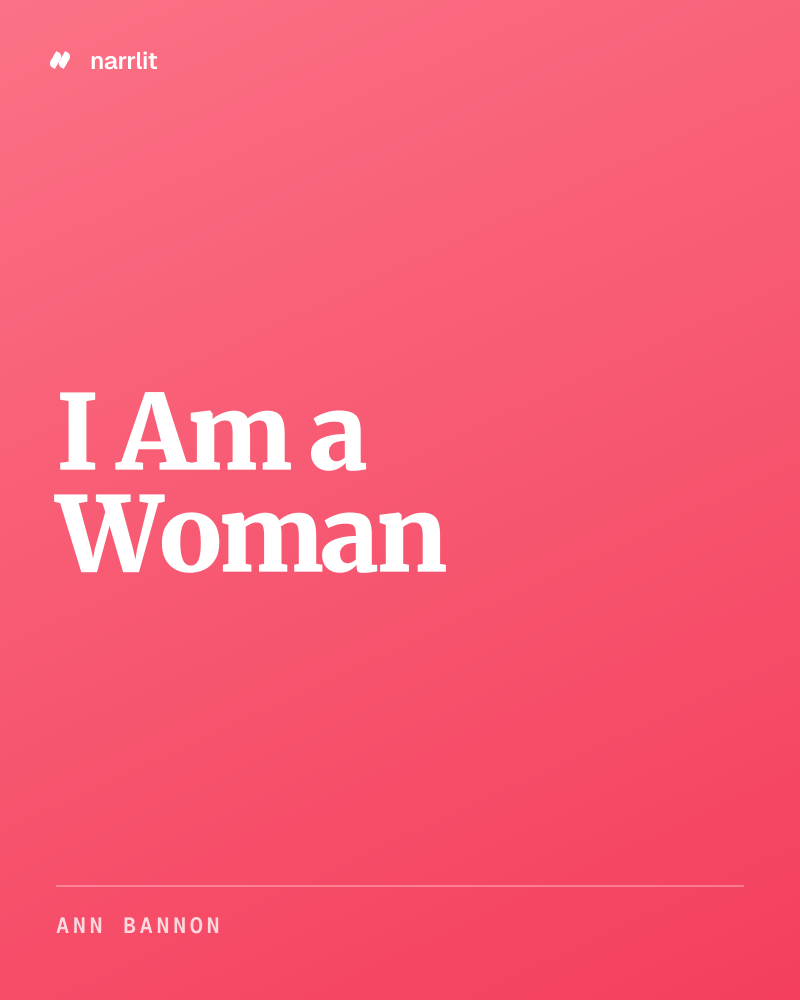
Ann Bannon · 37min
In the midcentury shadows of Greenwich Village, the search for selfhood becomes a radical act of survival. This landmark of pulp literature traces the heavy costs of living authentically. Join us.
“We selected I Am a Woman by Ann Bannon to explore its lasting influence on the evolution of romance. It provides a perfect canvas for debating the complex motives of its characters.”
Get this book free
Sign up and your first token is on us, use it to unlock permanently.
Laura Landon flees the suffocating influence of her father, Merrill, in Chicago to start an anonymous life in 1950s New York City. Traumatized by a childhood boating accident where her mother and brother drowned—a tragedy her father weaponizes to control her—Laura settles into a job as a medical secretary. She is determined to repress her sexuality after a devastating heartbreak with a woman named Beth during college. However, her resolve is tested when she moves in with Marcy, a beautiful woman entangled in a toxic divorce. Laura’s hidden desires resurface, leading to a botched attempt at intimacy that Marcy reveals was merely the subject of a cruel bet between her and her ex-husband to see if Laura would make a pass at her.
Devastated by this betrayal, Laura is drawn into the clandestine lesbian bars of Greenwich Village, where she meets the butch icon Bebo Brinker. Bebo’s physical resemblance to Beth triggers a cycle of projection and hostility in Laura, who struggles with deep internalized shame and the fear of being ostracized by society. This internal conflict reaches a boiling point when her father tracks her down at a journalism convention. In a disturbing confrontation in his hotel room, Merrill reveals an incestuous obsession with Laura, viewing her sexuality as a relief because it means no other man will take her away from him. Laura strikes him with a heavy glass ashtray, finally severing his psychological hold over her.
The narrative resolves with Laura achieving self-actualization through the guidance of Jack, a gay mentor. She realizes she has been chasing ghosts by projecting her past trauma onto Marcy and Bebo. Abandoning her defensive masks, she returns to Bebo, accepting her for who she is rather than as a replacement for Beth. The book concludes with Laura choosing to live an authentic, if socially precarious, life within the Village community, finally free from the ghosts of her Chicago upbringing.
I Am a Woman was written by Ann Bannon and originally published in 1959. Bannon, the pen name for Ann Weldy, became known as the "Queen of Lesbian Pulp Fiction" for her series known as The Beebo Brinker Chronicles. Written during the height of the Lavender Scare and McCarthyism, the book reflects a period of intense legal and medical repression for gay individuals in the United States. While pulp novels of the era often required tragic endings to satisfy censors, Bannon’s work was landmark for its relatively sympathetic and nuanced portrayal of lesbian life and its refusal to completely destroy its protagonists. The book serves as a vital historical record of the mid-century Greenwich Village underground scene, capturing the specific dress codes, social rituals, and constant threat of police intervention that defined the era before the modern gay rights movement took shape.
Laura’s journey is defined by her struggle to accept her identity in a hostile era. She views her own desires as a 'festering wound' and treats the lesbian community at The Cellar with defensive hostility. A concrete example of this is when she lashes out at Bebo Brinker, attacking Bebo's masculine presentation because Bebo represents the very visibility Laura fears. Her shame is so profound that she initially prefers a sterile, asexual life over the risk of being identified as gay.
The narrative illustrates how unresolved trauma causes individuals to recreate past heartbreaks. Laura projects her feelings for her first love, Beth, onto every woman she meets. She is drawn to Marcy because she is an unavailable straight woman, echoing the dynamic of her failed relationship. Later, she uses Bebo as a physical vessel for Beth's ghost, even calling Bebo by the wrong name during an intimate moment, proving she is trying to rewrite her history rather than live her present.
Central to the book is Laura’s literal and figurative battle against her father, Merrill Landon. He uses psychological suffocation and survivor's guilt to keep her subservient. The theme culminates in the hotel room confrontation where Laura realizes her father’s control is rooted in a sick, incestuous possessiveness. By striking him with an ashtray and fleeing, Laura physically breaks the spell of patriarchal authority that has dictated her life since the childhood boating accident that killed her mother.
Moments from Jasper and Maya's discussion of I Am a Woman:
“Merrill Landon is not merely a strict parent, he is a psychological suffocator.”
— Maya
“You cannot outrun your own psychology.”
— Jasper
“Bebo wearing men's clothing is a daily walking act of defiance that could get her arrested.”
— Maya
“Our protective masks are actually the very prisons that keep us from finding love and connection.”
— Jasper
“In the 1950s, being gay wasn't just a social taboo, it was a criminal offense.”
— Maya
I Am a Woman follows Laura Landon as she flees her controlling father in Chicago to start a new life in 1950s New York City. The story explores her journey through the underground lesbian bars of Greenwich Village as she struggles to reconcile her traumatic past with her search for an authentic identity. It ultimately centers on her liberation from social and familial repression.
The book was written by Ann Bannon, a pseudonym for Ann Weldy, and was published in 1959. It is the second installment in her famous five-book series known as The Beebo Brinker Chronicles.
The narrlit episode discussing I Am a Woman has a total runtime of 37 minutes. The hosts cover the entire plot, character motivations, and historical context of the novel.
Yes, it is considered a foundational text of lesbian literature that offers a rare, first-hand look at queer life in the mid-20th century. While it contains the heightened drama typical of pulp fiction, its psychological insights into trauma and identity remain relevant. Readers often appreciate it for its complex characters and its depiction of the resilience required to live authentically during a period of intense social conformity.