 narrlitnarrlit
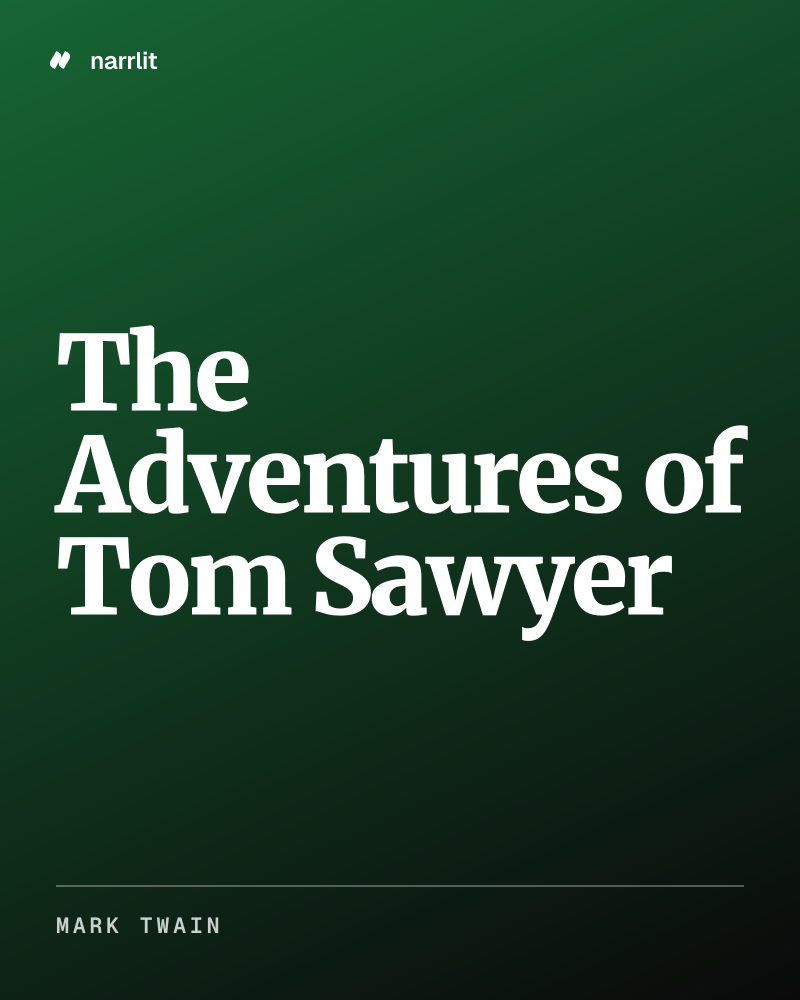
Mark Twain · 1h01min
The Mississippi riverbank serves as the stage for this enduring study of childhood innocence lost to the shadows of reality. Mischief meets a haunting secret. Listen to our latest discussion.
“We selected The Adventures of Tom Sawyer by Mark Twain to explore its lasting influence on the evolution of classics. It provides a perfect canvas for debating the complex motives of its characters.”
Get this book free
Sign up and your first token is on us, use it to unlock permanently.
The Adventures of Tom Sawyer is set in the 1840s in St. Petersburg, Missouri, a fictionalized version of Mark Twain’s childhood home. The narrative follows Tom, an imaginative orphan living with his Aunt Polly, as he constantly rebels against the rigid religious and social structures of his community. Early chapters establish Tom as a master manipulator who avoids labor through psychological tricks, most famously convincing his peers to pay him for the privilege of whitewashing a fence. His life is defined by a series of games, including a performative pursuit of his classmate Becky Thatcher and a fraudulent scheme to win a Sunday school Bible by trading for tickets rather than memorizing verses.
The tone shifts dramatically when Tom and the local outcast Huckleberry Finn witness Injun Joe murder a doctor in a graveyard. This event forces the boys into a terrifying reality where their childish games of pirates and outlaws collide with genuine danger. They flee to Jackson’s Island to escape the pressure of their secret, allowing the town to mourn them as dead before returning to attend their own funeral. This stunt represents the peak of Tom's narcissism, though he later exhibits true moral growth by testifying against Injun Joe in court to save the wrongly accused Muff Potter.
The conflict resolves when Tom and Becky become trapped in McDougall’s Cave during a picnic. Tom discovers Injun Joe is using the cave as a hideout but manages to navigate himself and Becky to safety. After the cave is sealed by the town, Joe starves to death, and the boys recover a hidden stash of gold worth $12,000. While the story ends with Tom and Huck becoming wealthy heroes, the resolution is bittersweet. Huck is forced into the stifling respectability of the Widow Douglas’s care, suggesting that their successful rebellion has ironically resulted in their permanent institutionalization within the society they once defied.
Mark Twain, the pen name of Samuel Clemens, published The Adventures of Tom Sawyer in 1876. A former riverboat pilot and satirical journalist, Twain drew heavily from his upbringing in Hannibal, Missouri, to construct the fictional village of St. Petersburg. Although written in the post-Civil War era, the novel is a nostalgic yet critical reconstruction of the antebellum 1840s. This period in the American Midwest was characterized by a sharp divide between the untamed Mississippi frontier and emerging towns that enforced strict Calvinist moral codes. Twain’s work broke from the era's tradition of moralizing children's literature, which typically featured perfectly obedient protagonists. Instead, he presented a realistic, flawed hero who navigates a world of violence, superstition, and social hierarchy. The novel established the American boy as a central figure in literary fiction and provided the thematic foundation for its more experimental sequel, The Adventures of Huckleberry Finn.
Tom navigates his world not through strength, but by altering the perceptions of those around him. In the famous whitewashing scene, he avoids manual labor by framing a chore as an exclusive artistic privilege. By treating the brush strokes with professional gravity, he convinces Ben Rogers and others to trade their prized possessions for the opportunity to work. This reveals Tom’s innate understanding of human desire: that people covet whatever is made to appear difficult to attain.
In St. Petersburg, status is tied to the outward display of religious and civic duty. Characters like Sid weaponize their compliance with rules to gain moral high ground over Tom. Similarly, Tom’s Sunday school scam involves laundering his wealth into Bible tickets to win a prize he did not earn, simply to gain the approval of Judge Thatcher. The town’s adults are equally performative, suppressing laughter during a chaotic church service to maintain their facade of solemnity.
Tom initially views danger through the lens of romanticized literature, playing at being a pirate or Robin Hood where death is a temporary game. This innocence is shattered when he witnesses the brutal murder of Dr. Robinson in a graveyard. The transition from the imaginary blood of his games to the real blood of the crime scene forces Tom to mature. He eventually trades his theatrical silence for a risky, real-world testimony that carries actual lethal consequences.
Moments from Jasper and Maya's discussion of The Adventures of Tom Sawyer:
“The adult world is governed by the severe Calvinist church sermons, relentless domestic chores, and this really powerful fear of losing respectability.”
— Maya
“In order to make a person covet a thing, it is only necessary to make the thing difficult to attain.”
— Maya
“He essentially becomes a behavioral economist in short pants.”
— Jasper
“The blood oath isn't a game of pirates; it highlights the intense vulnerability of children when they collide with the darkest aspect of the adult world.”
— Maya
“The wealth doesn't liberate them, it institutionalizes them.”
— Jasper
The novel follows a young boy named Tom Sawyer growing up in a Missouri river town as he navigates the tensions between childhood rebellion and the strict social codes of the 1840s. The story shifts from lighthearted schoolboy pranks to a dangerous struggle for survival after Tom witnesses a murder and gets lost in a vast cave system.
Mark Twain, the pen name for Samuel Clemens, published the novel in 1876. He drew heavily from his own experiences growing up on the banks of the Mississippi River in the mid-nineteenth century.
Yes, the original text of the novel is in the public domain because it was published well before the current copyright cutoff. Readers can legally access the book through various free digital archives and libraries.
The discussion hosted by Jasper and Maya lasts for approximately one hour and one minute. They cover the entire plot arc, from the iconic whitewashing of the fence to the discovery of the hidden treasure.