 narrlitnarrlit
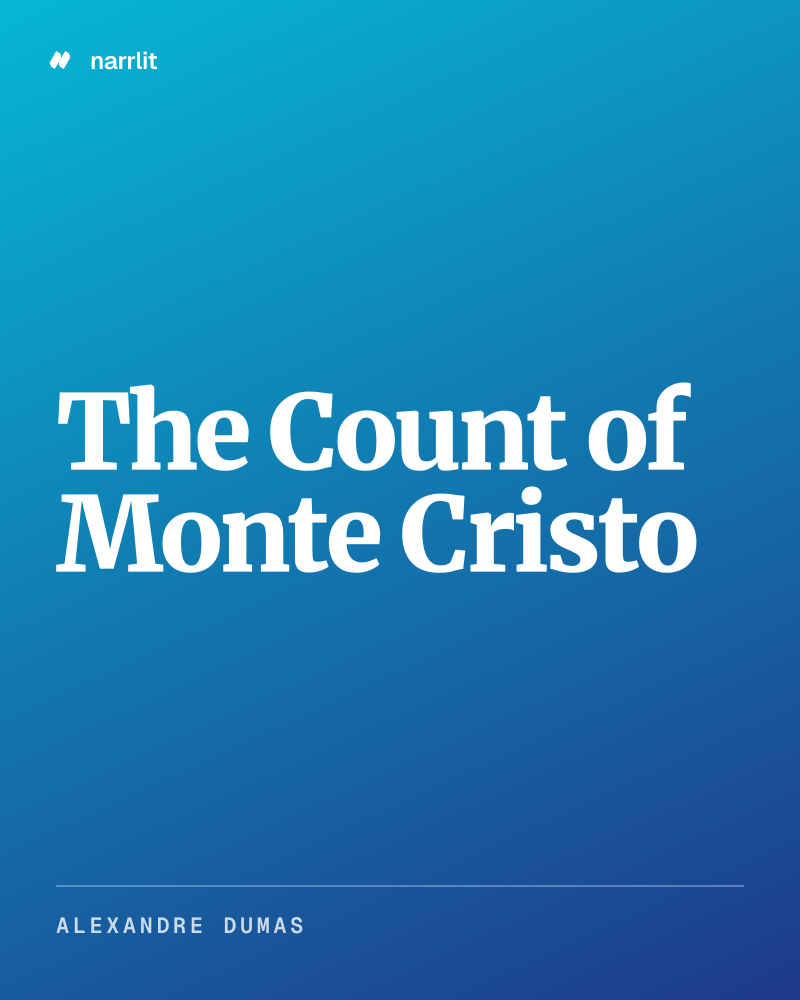
Alexandre Dumas · 1h01min
Falsely imprisoned for years, young Edmond Dantès transforms into the enigmatic Count of Monte Cristo, seeking meticulous revenge on those who wronged him. An epic tale of justice, betrayal, and redemption.
“We selected The Count of Monte Cristo by Alexandre Dumas to explore its lasting influence on the evolution of classics. It provides a perfect canvas for debating the complex motives of its characters.”
Get this book free
Sign up and your first token is on us, use it to unlock permanently.
Edmond Dantès is a nineteen-year-old sailor in 1815 Marseille who is about to be promoted to captain and marry his love, Mercedes. His rapid success provokes the envy of his shipmate Danglars and his rival Fernand. Together, they frame Dantès as a Bonapartist spy. During his interrogation, the deputy prosecutor Villefort discovers that Dantès carries a letter addressed to Villefort’s own father, a known revolutionary. To protect his political reputation, Villefort burns the letter and sentences Dantès to solitary confinement in the Chateau d'If without a trial.
Dantès spends fourteen years in a damp stone cell, descending into suicidal despair until he meets Abbé Faria, a fellow prisoner. Faria becomes a mentor, educating Dantès in languages, science, and history while deducing the identities of those who betrayed him. Before dying, Faria reveals the location of a massive treasure hidden on the island of Monte Cristo. Dantès escapes by sewing himself into Faria's burial shroud and being thrown into the sea. Once free, he retrieves the fortune and spends years assuming various identities to infiltrate the lives of his enemies, who have since become wealthy and powerful figures in Parisian society.
The Count meticulously destroys his betrayers through psychological and financial warfare. He ruins Fernand’s reputation by exposing his past war crimes, leading Fernand to commit suicide. He exploits the greed of Villefort's wife, which results in a series of poisonings within the prosecutor’s household and drives Villefort to madness. Finally, he bankrupts Danglars. However, when the vengeance leads to the death of Villefort’s innocent young son, the Count realizes he has overstepped his moral authority. He ultimately grants mercy to Danglars, provides for the children of his allies, and sails away, concluding that all human wisdom is contained in the words 'wait and hope.'
Alexandre Dumas published The Count of Monte Cristo between 1844 and 1846, originally as a serialized novel in a French journal. Written during the Romantic era, the book is set against the volatile historical backdrop of the Bourbon Restoration and the Hundred Days of Napoleon's return to power. This period of political paranoia in France is central to the plot, as the shifting allegiances between Royalists and Bonapartists make the accusation of treason against Dantès plausible. Dumas, often assisted by his collaborator Auguste Maquet, was a prolific writer known for his ability to weave historical reality with high adventure. His own father, a general of mixed-race descent who was unjustly imprisoned and died in poverty, likely influenced the novel's themes of legal injustice and social mobility. The work remains a foundational text in the revenge thriller genre, reflecting nineteenth-century anxieties about class, meritocracy, and the fallibility of the legal system.
The novel argues that official legal systems are often instruments of personal ambition rather than moral truth. This is demonstrated when the prosecutor Villefort realizes Dantès is innocent but sends him to prison anyway to protect his own career and his father's reputation. Because the law fails to protect the innocent, the protagonist concludes that he must act as an independent agent of providence to correct the scales that the state ignored.
While the story begins as a pursuit of righteous payback, it evolves into an exploration of the collateral damage caused by such a mission. The Count believes he is a surgical instrument of God, but the death of the innocent child Edward de Villefort shatters his certainty. This tragedy forces him to recognize that human beings cannot unleash destructive forces without harming the blameless, eventually leading him to choose mercy over total annihilation.
Transformation in the book is rooted in education rather than just wealth. During his years in the Chateau d'If, Dantès receives a comprehensive university-level education from Abbé Faria. This mental training allows a simple sailor to reinvent himself as a sophisticated aristocrat capable of navigating high society. Faria's mentorship proves that intellectual development is the primary tool for overcoming physical captivity and executing complex, long-term strategies.
Moments from Jasper and Maya's discussion of The Count of Monte Cristo:
“When someone has everything at such a young age, they tend to become like a walking mirror for the insecurities of everyone around them.”
— Jasper
“It is a clinical look at the psychological cost of deciding that you have the right to play God.”
— Maya
“He takes a capable but uneducated sailor and painstakingly molds him into a hyper educated, sophisticated aristocrat in waiting.”
— Maya
“You cannot unleash a firestorm and dictate what it burns.”
— Jasper
“Sparing Danglars is the count reclaiming his own humanity.”
— Maya
The novel follows Edmond Dantès, a sailor who is falsely accused of treason and imprisoned for fourteen years without a trial. After escaping and finding a hidden treasure, he adopts the persona of the Count of Monte Cristo to reward those who were kind to him and systematically destroy the men responsible for his suffering.
The book was written by Alexandre Dumas, a French author famous for historical adventure novels. It was originally published in serialized installments between 1844 and 1846.
The protagonist is Edmond Dantès, an honest sailor who undergoes a massive transformation during his long imprisonment. Throughout the second half of the book, he operates under various aliases, most notably the wealthy and mysterious Count of Monte Cristo.
The book remains highly relevant for its deep psychological exploration of justice, trauma, and the limits of human power. While it is an epic adventure, it also serves as a cautionary tale about the emotional and moral exhaustion that comes with living a life dedicated entirely to revenge.