 narrlitnarrlit
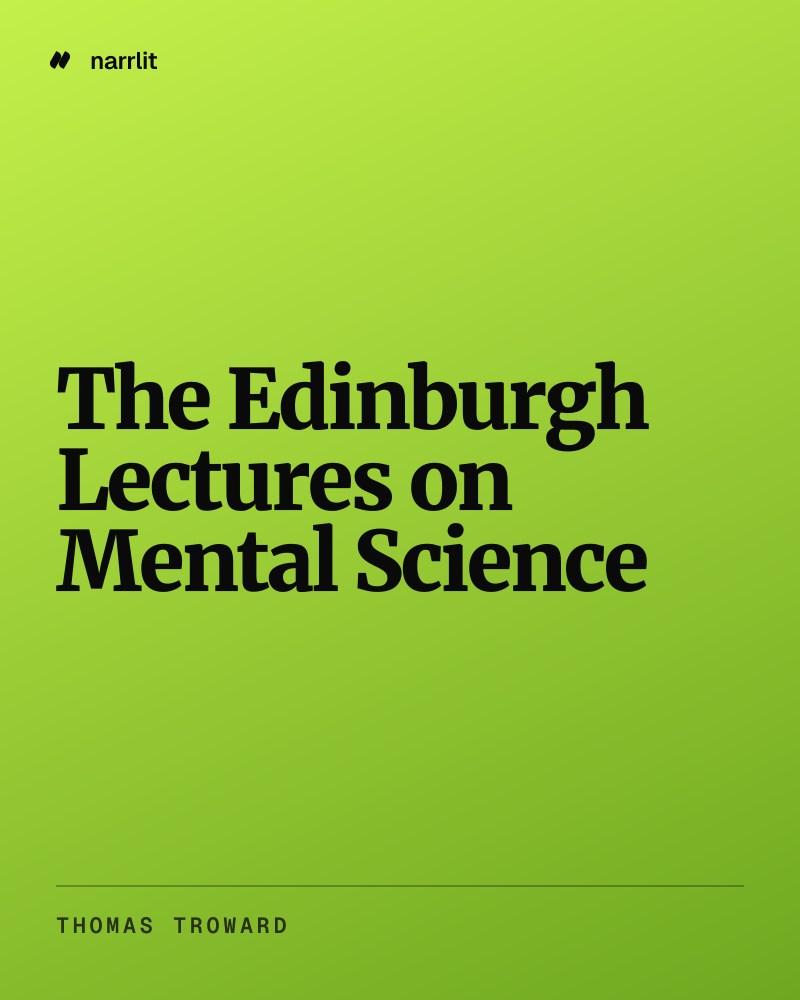
Thomas Troward · 41min
The power of thought remains the ultimate frontier of human agency. Troward bridges the gap between material reality and the subjective mind. Enter a world where spirit governs form.
“We selected The Edinburgh Lectures on Mental Science by Thomas Troward to explore its lasting influence on the evolution of philosophy. It provides a perfect canvas for debating the complex motives of its characters.”
Get this book free
Sign up and your first token is on us, use it to unlock permanently.
Thomas Troward presents a logical framework for understanding the relationship between human thought and physical reality. He begins by challenging the concept of dead matter, arguing that all substance is a form of vibrating energy characterized by varying degrees of intelligence. The book distinguishes between the objective mind, which functions through observation and inductive reasoning, and the subjective mind, which operates purely through deduction. Because the subjective mind cannot reject suggestions and is the primary builder of the physical body, Troward argues that human health and external circumstances are direct reflections of the premises held by the conscious intellect.
A central conflict arises between the law of averages—nature's impersonal survival mechanisms—and individual volition. Troward posits that as humans evolve, they gain the ability to transcend biological fate by consciously cooperating with universal laws. He uses the analogy of an electrician who gains power over electricity by first submitting to its inherent properties. In this system, free will is not a tool for forcing external change but a mechanism for holding a steady mental image. By maintaining a spiritual prototype in the everlasting now, an individual creates a nucleus that magnetically attracts the necessary physical conditions for manifestation.
The resolution of the text bridges philosophy and physiology, mapping these mental functions onto the nervous system. Troward identifies the vagus nerve as the physical link between the reasoning brain and the subconscious solar plexus. He concludes that the originating spirit of the universe is a creative, lifeward force of love. Consequently, suffering is not a divine punishment but a result of swimming upstream against the natural flow of reality. To change one's life, one must stop fighting negative conditions and instead introduce positive mental causes, allowing the law of growth to produce new results.
Thomas Troward was a British divisional judge in Punjab, India, whose judicial background heavily influenced the logical, evidence-based structure of his metaphysical writings. First delivered as a series of lectures in 1904, The Edinburgh Lectures on Mental Science appeared at a pivotal moment in history when classical Newtonian physics began to give way to early quantum concepts. Troward wrote during the height of the New Thought movement, a period characterized by a desire to reconcile traditional religious belief with the emerging sciences of psychology and biology. His work is distinct for its lack of emotionalism, instead treating the mind as a precise mechanical system. By applying the rigor of a legal mind to the unseen world of spirit, Troward sought to provide a manual for human agency that bypassed or replaced superstition. The book remains a cornerstone text for the science of mind, influencing decades of later psychology by framing consciousness as the primary cause of material form.
Troward divides human consciousness into the objective and subjective minds. The objective mind acts as a gatekeeper, using inductive reasoning to evaluate the world. The subjective mind, or subconscious, is incapable of rejecting any premise and acts with blind fidelity. For example, the hosts use the analogy of a submarine: the objective mind is the captain looking through a periscope, while the subjective mind is the engine room crew that follows orders even if they lead toward a reef.
True agency comes not from rebelling against nature, but from understanding its rules. Troward argues that nature obeys us only in proportion as we first obey nature. An example is the electrician who harnesses lethal energy not by changing physical laws, but by respecting the conductivity of copper and the constraints of circuits. By aligning individual thought with universal principles, the individual gains access to the power behind the physical world rather than struggling against it.
Troward distinguishes between primary causes and secondary conditions. Negative experiences like sickness or poverty are viewed not as independent entities, but as the absence of light. The book illustrates this with the candle analogy: to remove darkness from a room, one does not sweep it out with a broom but simply introduces a light source. Similarly, one changes life circumstances by focusing on the absolute spiritual prototype of health or abundance rather than fighting the symptoms.
Moments from Jasper and Maya's discussion of The Edinburgh Lectures on Mental Science:
“Intelligence becomes the true measure of livingness for Troward.”
— Maya
“The defining quality of spirit is thought, and the defining quality of matter is form.”
— Jasper
“Nature obeys us precisely in proportion as we first obey nature.”
— Jasper
“The subjective mind is fundamentally incapable of inductive reasoning.”
— Maya
“The business of the will is simply to maintain a peaceful, calm determination to hold a certain mental attitude regardless of external temptations to panic.”
— Jasper
“Your skin is not your boundary.”
— Jasper
The book explores the relationship between the human mind and the universal spirit, arguing that thought is the primary cause of physical reality. Troward provides a logical system showing how the subconscious mind builds the body and environment based on conscious suggestions. It frames human evolution as the emergence of the power to dictate one's own conditions through mental discipline.
The book was written by Thomas Troward, a retired British judge who served in India. It was originally published in 1904 as a collection of his public lectures delivered in Edinburgh.
The Narrlit discussion of Troward's lectures is 41 minutes long. Hosts Jasper and Maya spend this time breaking down the book's complex psychological and physiological arguments into accessible analogies.
It remains relevant for those interested in the history of psychology and the philosophical roots of self-improvement. Troward’s focus on the mechanics of belief and his early anticipation of neuroplasticity offer a more rigorous perspective than many modern works in the same genre.