 narrlitnarrlit
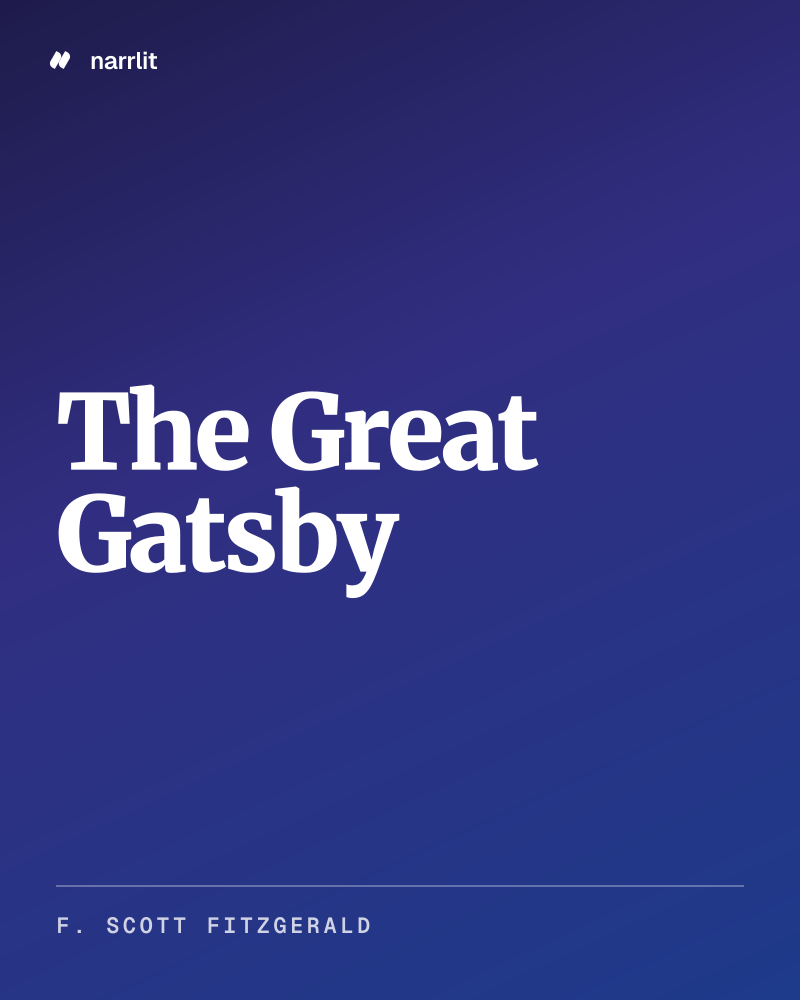
F. Scott Fitzgerald · 47min
Step into the Jazz Age's lavish parties and hidden desires. Nick Carraway unravels the mystery of Jay Gatsby, a self-made millionaire obsessed with reliving the past. A poignant tale of wealth, love, and the elusive American Dream.
“We selected The Great Gatsby by F. Scott Fitzgerald to explore its lasting influence on the evolution of classics. It provides a perfect canvas for debating the complex motives of its characters.”
Get this book free
Sign up and your first token is on us, use it to unlock permanently.
Narrator Nick Carraway moves to West Egg, Long Island in 1922, where he encounters his neighbor, Jay Gatsby. Gatsby is a mysterious millionaire who hosts extravagant parties in an effort to attract the attention of Nick's cousin, Daisy Buchanan. Daisy lives across the bay in the more established East Egg with her wealthy and domineering husband, Tom. Through Nick, Gatsby and Daisy reunite, but Gatsby’s attempt to recapture the past eventually leads to a confrontation where Tom exposes Gatsby’s criminal activities, causing Daisy to choose her social security over her romantic feelings.
The narrative shifts toward disaster when Daisy, driving Gatsby’s yellow car, accidentally strikes and kills Tom’s mistress, Myrtle Wilson, in the industrial wasteland known as the Valley of Ashes. Gatsby decides to take the blame to protect Daisy, but Tom manipulates Myrtle’s husband into believing Gatsby was both the driver and the mistress's lover. This results in the murder of Gatsby in his own pool, followed by the husband's suicide.
Following the tragedy, Nick is disillusioned by the moral vacuum of the East Coast. He discovers that none of the guests who frequented Gatsby’s parties are willing to attend his funeral, including Daisy and Tom, who flee the area. Nick concludes that Gatsby possessed a unique, if misguided, capacity for hope symbolized by the green light on Daisy’s dock. He ultimately characterizes the Buchanans as careless people who use their vast wealth to escape the consequences of the destruction they leave in their wake.
F. Scott Fitzgerald wrote The Great Gatsby during a period of significant transition in American history, publishing it in 1925. Living as an expatriate in France at the time, Fitzgerald captured the frantic energy and underlying hollows of the Roaring Twenties. This era was defined by the economic boom following World War I, the rise of organized crime due to Prohibition, and the shift from traditional values to a more cynical, consumer-driven culture. The novel serves as a critique of the American Dream, suggesting that the promise of upward mobility is often blocked by rigid class structures. While not an immediate commercial success, the book gained prominence later as a definitive work of modernist literature. It utilizes a restrained, first-person perspective to explore the intersection of personal obsession and national identity, illustrating the specific social hierarchies of the North American Northeast during the early 20th century.
Gatsby represents the belief that anyone can achieve success through hard work and ingenuity. However, his success is built on bootlegging and organized crime, suggesting the dream is tainted by the methods used to achieve it. Even with extreme wealth, Gatsby is never accepted by the old-money elite. Tom Buchanan’s exposure of Gatsby’s criminal ties at the Plaza Hotel causes Daisy to reject Gatsby in favor of Tom’s institutional security, proving wealth alone cannot grant social entry.
The novel distinguishes between new money in West Egg and old money in East Egg. Despite Gatsby’s enormous wealth, he lacks the social cues and inherited standing of the Buchanans. This divide is illustrated by the uncut pages in Gatsby's library; while the books are real, they are props for a performance of intellectualism he has not inherited. The Buchanans use their status as armor, remaining careless while the working class, like Myrtle and George Wilson, pay for their mistakes.
Gatsby’s central motivation is the desire to repeat the past and erase the years Daisy spent with Tom. He views his wealth as a tool to manipulate history, a belief physically manifested when he knocks over a defunct clock at Nick’s house during his first reunion with Daisy. His attempt to catch the falling clock mirrors his doomed effort to stop time. Ultimately, the narrative concludes that individuals are borne back ceaselessly into the past, unable to escape history.
Moments from Jasper and Maya's discussion of The Great Gatsby:
“God has been replaced by an abandoned advertisement watching impartially over moral decay.”
— Jasper
“Gatsby isn't just in love with a woman, he is in love with an economic ideal.”
— Jasper
“Old money operates on this invisible frequency of shared history, subtle speech patterns, and inherited arrogance.”
— Maya
“The social contract of East Egg is essentially a conspiracy of silence.”
— Maya
“They were careless people, Tom and Daisy. They smashed up things and creatures and then retreated back into their money.”
— Jasper
“Intelligence and awareness only bring pain in her environment. She wants her daughter to be a fool, so she has spared the agony of recognizing her own entrapment.”
— Maya
The novel follows Jay Gatsby, a mysterious millionaire who uses his massive fortune to win back his former lover, Daisy Buchanan. Narrated by Nick Carraway, the story explores the clash between Gatsby’s idealistic obsession and the cynical, careless world of the established wealthy. It ends in tragedy when Gatsby’s pursuit of the past leads to his death at the hands of those he tried to emulate.
F. Scott Fitzgerald wrote the novel, and it was published in 1925 by Charles Scribner's Sons. He wrote much of the manuscript while living on the French Riviera, though the story is set in New York and Long Island in 1922.
Yes, the novel entered the public domain in the United States on January 1, 2021. This means the original text can now be legally adapted, republished, or used by anyone without permission from the Fitzgerald estate.
The story is narrated by Nick Carraway, a veteran from the Midwest who moves to New York to enter the bond business. While Jay Gatsby is the central figure the plot revolves around, the reader experiences the world and its moral judgments through Nick's perspective.