 narrlitnarrlit
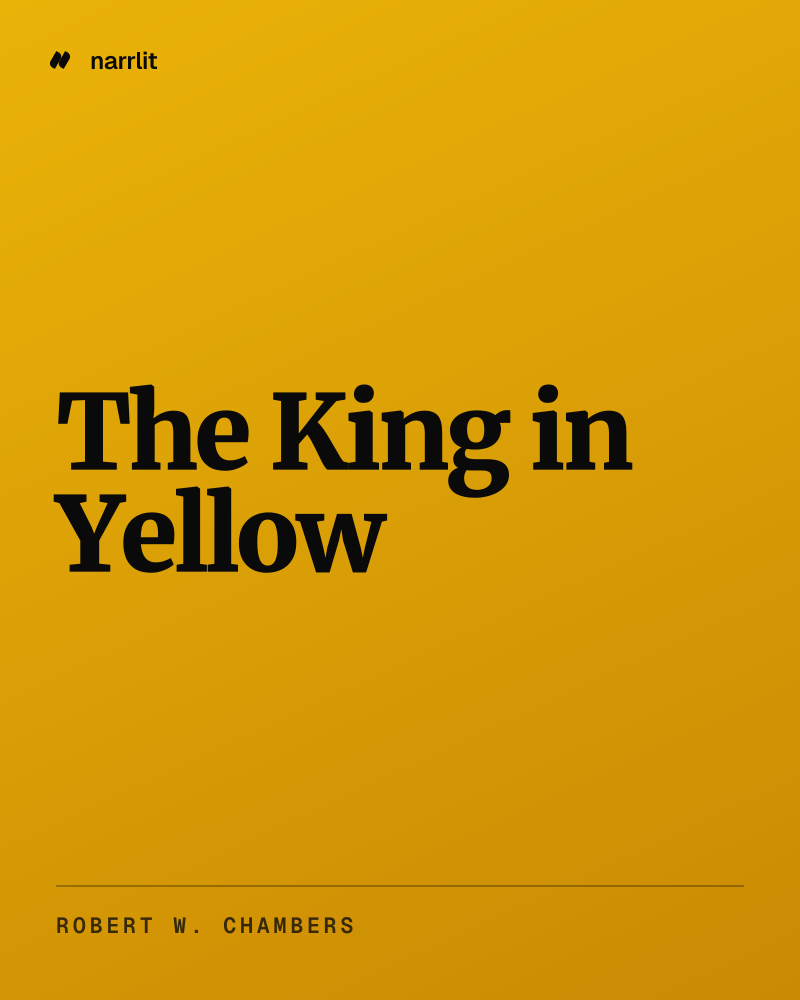
Robert W. Chambers · 40min
Dive into Robert W. Chambers' unsettling collection, where a forbidden play, "The King in Yellow," unravels minds and realities. Explore themes of cosmic horror and psychological decay in this classic of the uncanny.
“We selected The King in Yellow by Robert W. Chambers to explore its lasting influence on the evolution of weird fiction. It provides a perfect canvas for debating the complex motives of its characters.”
Get this book free
Sign up and your first token is on us, use it to unlock permanently.
The collection begins with 'The Repairer of Reputations,' set in a dystopian 1920s America where the narrator, Hildred Castane, descends into homicidal delusion after reading the forbidden play, The King in Yellow. Influenced by the grotesque Mr. Wilde, Hildred believes he is the heir to an imperial dynasty connected to the alien city of Carcosa. This segment establishes the play as a pathogenic text that shatters the reader's psyche. In 'The Mask' and 'The Yellow Sign,' the horror shifts into more intimate and supernatural settings. 'The Mask' features a chemical pool that petrifies living things into marble, while 'The Yellow Sign' depicts an artist and his model haunted by a rotting watchman after they succumb to the play’s nihilistic influence.
The narrative structure then pivots sharply away from cosmic dread toward the realism of late nineteenth-century France. 'The Street of the First Shell' portrays the grim realities of the Siege of Paris in 1870, focusing on starvation, espionage, and the emotional burden of hidden pasts. Here, the horror is historical rather than supernatural, as characters navigate a city under bombardment and struggle with moral dilemmas. The collection concludes with two romantic stories, 'The Street of Our Lady of the Fields' and 'Rue Barree.' These tales discard the supernatural entirely, focusing on young American art students in the Latin Quarter who find redemption through unjudging love and artistic passion.
The resolution of the book lies in this tonal shift. While the earlier stories suggest that the human mind is fragile and easily dismantled by cosmic truths, the later stories argue that the human heart is resilient. The transition from the lethal chambers of a fictional New York to the silent, romantic acceptance of a Parisian garret suggests that human connection serves as the only viable defense against the pervasive despair symbolized by the King.
Robert W. Chambers published The King in Yellow in 1895 during a period of significant transition in gothic and horror literature. Chambers was a classically trained American artist who spent several years in Paris, an experience that heavily informed the second half of the collection. The book belongs to the Decadent movement of the late nineteenth century, drawing on themes of social decay, aestheticism, and the uncanny. While Chambers later became a prolific writer of popular romance novels, this early work remains his most influential contribution to weird fiction. It predates and influenced the cosmic horror of later authors like H.P. Lovecraft, who incorporated Chambers’ invented mythology—including names like Hastur and Carcosa—into the Cthulhu Mythos. The collection’s unique structure, moving from futuristic dystopia and cosmic terror to grounded bohemian realism, reflects the anxieties of the fin de siècle, where traditional social structures were challenged by new scientific and psychological perspectives.
The text presents madness not as a slow decline but as a sudden shattering triggered by exposure to forbidden truth. In 'The Repairer of Reputations,' Hildred’s mental stability is compromised by a head injury and destroyed by reading the play. The book suggests that the human mind is a thin veneer covering a void of nihilism. If the mask of societal reality is removed, as it is for the readers of the play, the resulting psychic collapse is irreversible and often leads to violence.
Many stories equate emotional repression with physical stasis. In 'The Mask,' Alec and Genevieve hide their mutual love to maintain social harmony, a dynamic mirrored by Boris’s chemical pool that turns living things into cold marble. This theme suggests that living a lie—wearing an emotional mask—is a form of self-petrification. Only when these secrets are confessed in a moment of crisis does the stone warm back into life, allowing for genuine human connection and psychological survival.
Chambers juxtaposes the supernatural dread of the King in Yellow with the visceral, man-made horror of war. In 'The Street of the First Shell,' characters endure the Siege of Paris, facing starvation and artillery fire. By placing these gritty accounts alongside stories of alien gods, Chambers implies that human conflict and cosmic indifference produce the same state of powerlessness. The abyss is found both in the black stars of Carcosa and the blood-soaked trenches of the nineteenth-century battlefield.
Moments from Jasper and Maya's discussion of The King in Yellow:
“The words just begin to completely dismantle your reality.”
— Maya
“Chambers is placing the horror of the real historical world side by side with the horror of the supernatural.”
— Maya
“The characters know they are doomed long before the rotting man breaks down the door.”
— Jasper
“Madness and destruction don't require an alien god, we manufacture them perfectly well ourselves.”
— Maya
“Hiding your true self to keep the peace is what truly turns you to stone.”
— Maya
“The abyss of Carcosa and the blood soaked trenches of Paris are two sides of the same coin.”
— Maya
The King in Yellow is a collection of short stories centered on a forbidden play that induces madness and despair in those who read it. The book transitions from supernatural and cosmic horror in a futuristic New York to grounded, romantic tales of artists living in nineteenth-century Paris. It explores how both cosmic forces and human emotions can dismantle an individual's sense of reality.
Robert W. Chambers, an American author and artist, published the collection in 1895. He wrote it during the late Victorian era, drawing on his professional experiences as an art student in the Parisian Latin Quarter.
Yes, the collection was published in 1895 and is currently in the public domain. Readers can access the full text for free through various digital archives and online libraries.
The narrlit episode discussing this book is 40 minutes long. Hosts Jasper and Maya use this time to analyze the collection’s structure, its mythological elements, and its shift from horror to bohemian realism.