 narrlitnarrlit
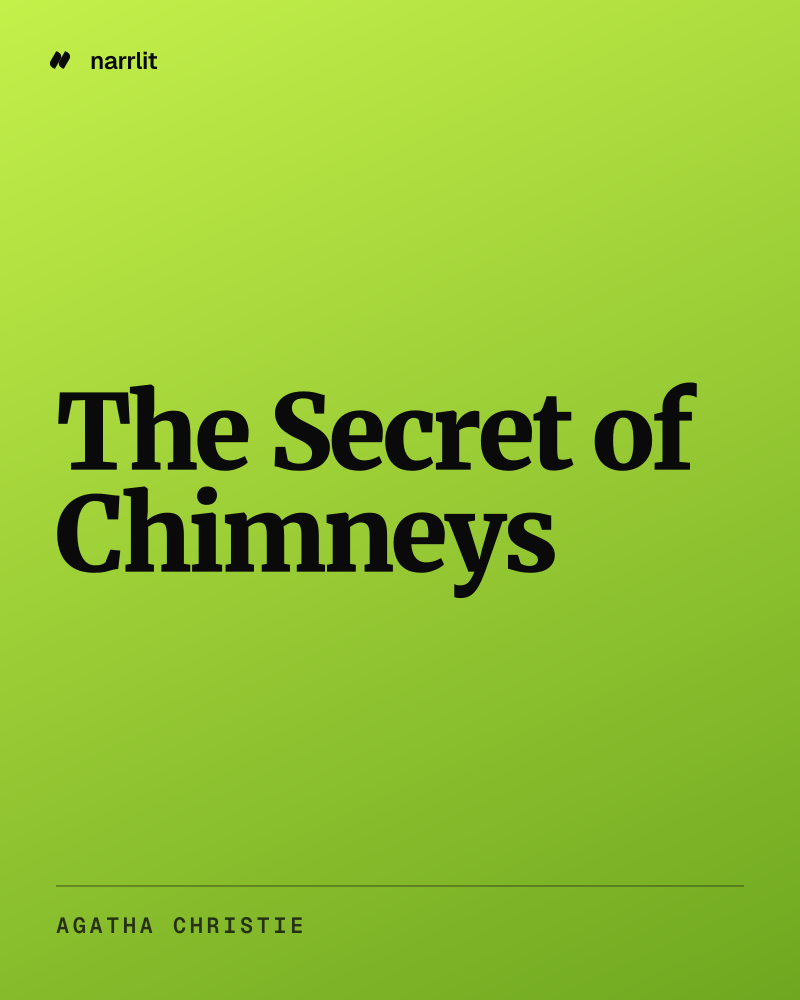
Agatha Christie · 20min
International intrigue meets the English country house in this spirited early caper. Stolen memoirs and a legendary thief spark a dangerous game of shadows. Follow the search for a kingdom’s heart.
“We selected The Secret of Chimneys by Agatha Christie to explore its lasting influence on the evolution of mystery & thriller. It provides a perfect canvas for debating the complex motives of its characters.”
Get this book free
Sign up and your first token is on us, use it to unlock permanently.
Anthony Cade, a charming adventurer working as a tour guide in Africa, accepts a job from his friend Jimmy McGrath to deliver the political memoirs of the late Count Stilptitch and a set of blackmail letters to London. Assuming the alias James McGrath, Anthony enters a web of international intrigue centered on Chimneys, the historic estate of Lord Caterham. The British government, led by the pompous George Lomax, is using the house to host a secret summit to restore the monarchy in the fictional state of Herzoslovakia in exchange for oil rights. The summit is thrown into chaos when Prince Michael of Herzoslovakia is found murdered in the council chamber. Superintendent Battle of Scotland Yard arrives to investigate a cast of suspects with hidden identities.
The plot revolves around the search for the Kohinoor diamond, stolen years earlier by the late Queen Veraga and hidden within the house. A master thief known as King Victor is believed to be after the gem, having followed the clues left in the Count’s memoirs. Anthony Cade works alongside Virginia Revel, a socialite who received the blackmail letters, to unravel the mystery while dodging police suspicion. In the resolution, Anthony unmasks the French detective Lemoine as actually being King Victor in disguise. He further reveals that the quiet governess, Mademoiselle Brunn, is the long-presumed-dead Queen Veraga. She killed Prince Michael to protect her secret and attempted to find the diamond hidden in a rose bush on the grounds.
The final twist reveals that Anthony Cade himself is the true heir to the Herzoslovakian throne, Prince Nicholas. He had abandoned his royal duties for a life of adventure but eventually chooses to return to his country as its king, bringing Virginia Revel with him as his consort.
Agatha Christie (1890-1976) wrote The Secret of Chimneys in 1925, during a period when the British Empire was grappling with the aftermath of World War I. This early work marks a transition from the traditional village mystery to a more expansive style of international thriller. Christie uses the fictional Balkan state of Herzoslovakia to represent the real-world political instability and revolutionary movements occurring in Eastern Europe at the time. The novel reflects the 1920s fascination with secret societies, master thieves, and the shifting fortunes of displaced royalty. Historically, it captures the tension between the traditional English aristocracy—personified by the reluctant Lord Caterham—and the emerging power of global finance and industrial interests like the oil trade. By setting the action in a grand country house that serves as a backdrop for clandestine diplomacy, Christie grounds the wilder elements of espionage in the familiar domestic setting that became her trademark.
The story operates on the premise that appearance rarely matches reality. Anthony Cade spends the novel as James McGrath before being revealed as Prince Nicholas, while the master thief King Victor successfully impersonates a renowned French detective. This theme highlights the fragility of social trust in a post-war world. A concrete example is Mademoiselle Brunn, who maintains a ten-year facade as a humble governess while actually being the ruthless former Queen Veraga, deceiving everyone around her for years.
Christie explores how class hierarchies create blind spots for characters and the police. Because the English aristocracy and the investigators view domestic staff as background figures, the murderer is able to operate within the house for years without scrutiny. For example, Mademoiselle Brunn uses her status as a governess to move freely through Chimneys, allowing her to commit murder and search for the diamond because no one considers her a person of consequence or potential threat.
The fictional state of Herzoslovakia serves as a microcosm for European geopolitical instability. The plot is driven by the echoes of a past revolution and the cold calculations of modern diplomacy, where oil rights are traded for royal restorations. A concrete example is George Lomax’s obsession with the secret memoirs; he is less concerned with the morality of the murder than with ensuring the political scandal does not jeopardize Britain’s industrial interests in the Balkan oil fields.
Moments from Jasper and Maya's discussion of The Secret of Chimneys:
“We are going to piece together a puzzle where literally no one is exactly who they claim to be.”
— Maya
“It really highlights his nine lives of a cat personality. He just breezes through committing a felony.”
— Jasper
“He looks like he doesn't understand anything but his mind is incredibly sharp.”
— Maya
“That is an amazing commentary on class blindness. No one looks twice at the governess.”
— Maya
“He gives them just enough truth to seem transparent.”
— Jasper
“He was raised to be a king. He just faked his death years ago because he hated court protocol.”
— Jasper
The novel follows Anthony Cade as he delivers political memoirs to London and becomes embroiled in a murder investigation at an ancestral estate. The plot involves international espionage, a hunt for a stolen diamond, and the secret political future of the fictional Balkan state of Herzoslovakia.
The book was written by Agatha Christie and first published in 1925. It is one of her early works that blends the traditional country house mystery with the thriller and espionage genres.
The central protagonist is Anthony Cade, a quick-witted adventurer who takes on an alias to deliver sensitive documents. By the end of the novel, he is revealed to be Prince Nicholas, the rightful heir to the Herzoslovakian throne.
The narrlit episode discussing the book is approximately 20 minutes long. The hosts, Jasper and Maya, provide a sequential retelling of the complex plot and explore the motivations of the large cast of characters.