 narrlitnarrlit
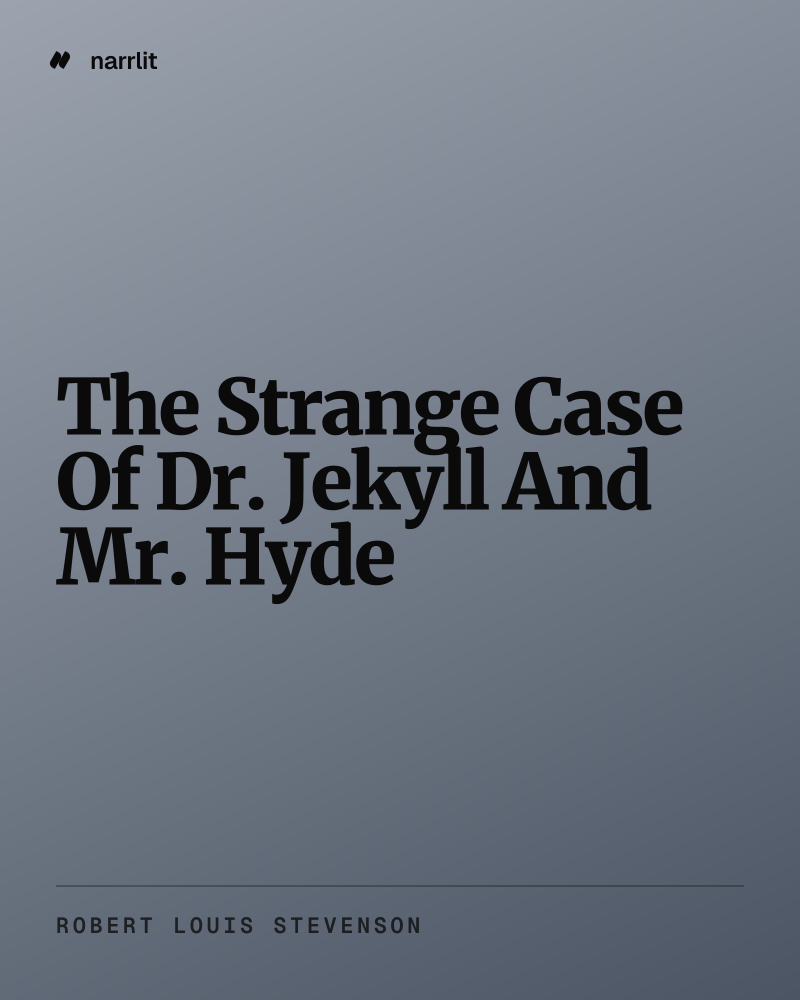
Robert Louis Stevenson · 1h02min
Unravel the chilling mystery of London's Dr. Jekyll and the malevolent Mr. Hyde. This Gothic tale delves into duality, morality, and the dark side of human nature, a timeless psychological thriller.
“We selected The Strange Case Of Dr. Jekyll And Mr. Hyde by Robert Louis Stevenson to explore its lasting influence on the evolution of classics. It provides a perfect canvas for debating the complex motives of its characters.”
Get this book free
Sign up and your first token is on us, use it to unlock permanently.
The story is framed as a detective mystery centered on Gabriel John Utterson, a lawyer who investigates the unsettling relationship between his friend, the respected Dr. Henry Jekyll, and a malevolent stranger named Edward Hyde. The narrative begins when Hyde tramples a child in the street and pays for the family's silence with a check signed by Jekyll. Utterson soon discovers that Jekyll has drafted a bizarre will leaving his entire fortune to Hyde, leading the lawyer to suspect that his friend is being blackmailed or is the target of a murder plot. This suspicion intensifies after Hyde brutally murders a member of parliament, Sir Danvers Carew, using a cane that Utterson knows belonged to Jekyll.
The mystery deepens as Jekyll becomes an absolute recluse, refusing to leave his laboratory for weeks at a time. After Jekyll’s friend Dr. Lanyon dies of a mysterious, terror-induced shock, Utterson and the butler, Poole, eventually break into the laboratory. They find the body of Hyde, who has died by suicide, dressed in Jekyll’s oversized clothing. Jekyll himself is nowhere to be found. Documents found at the scene include Lanyon’s eyewitness account of a horrific transformation and Jekyll’s own full written confession, which explains the hidden truth of the case.
Jekyll’s statement reveals that he discovered a chemical serum capable of separating the good and evil impulses within his soul. By transforming into Hyde, Jekyll could indulge in his darkest desires without social consequences. However, the Hyde persona grew stronger over time, eventually leading to spontaneous transformations and the murder of Carew. The experiment ultimately fails when Jekyll runs out of the specific, accidentally impure salt needed for the serum. Realizing he will soon transform into Hyde permanently and face the gallows, Jekyll ends his life. The book concludes with the understanding that Hyde was a manifestation of Jekyll’s own unintegrated shadow, fueled by the very repression that his social standing required.
Robert Louis Stevenson, a Scottish novelist and travel writer, published The Strange Case of Dr. Jekyll and Mr. Hyde in 1886. Written during the late Victorian era, the novella reflects the profound cultural anxieties of a society caught between traditional religious morality and the rapid advancements of science and psychology. This period was characterized by a rigid social code that prioritized public reputation and the concealment of private vices, a theme Stevenson explores through the shifting, fog-heavy landscape of London. The story emerged as early psychologists were beginning to study the subconscious and the potential multiplicity of the human self. Within the literary tradition of Gothic horror, Stevenson uses the physical transformation of his protagonist to externalize internal psychological conflict. The work also engages with evolutionary fears; by describing Hyde as troglodytic or ape-like, the author addresses contemporary concerns that humanity might revert to a primitive state if moral restraints were abandoned.
The characters live in a society that values surface decorum over emotional truth. Mr. Utterson polices his own desires with an iron fist, drinking gin alone specifically to punish his natural taste for fine wine. This culture of intense secrecy and self-denial creates the environment where Dr. Jekyll’s experiments flourish. Jekyll does not seek to be a villain; he simply wants to indulge his secret pleasures without losing his respectable status, leading to a catastrophic split in his identity.
Jekyll argues that man is not truly one, but truly two, suggesting that the human soul is a polity of independent denizens. He attempts to use science to isolate these parts, hoping his just side can pursue virtue while his unjust side enjoys total license. This is demonstrated when Jekyll looks in the mirror and recognizes the deformed Hyde as himself rather than a stranger. The theme suggests that denying one's shadow self only makes it more volatile and dangerous.
The book serves as a warning against using technology to bypass moral growth. Dr. Lanyon, a man of rational science, dies from the sheer shock of witnessing Jekyll’s transformation because it shatters his strictly materialist worldview. The ultimate failure of the experiment—caused by an accidental impurity in a batch of chemicals—shows that Jekyll’s control was always an illusion. His shortcut to moral efficiency results in a total loss of identity rather than the liberation he expected.
Moments from Jasper and Maya's discussion of The Strange Case Of Dr. Jekyll And Mr. Hyde:
“The architecture of the house serves as the literal blueprint of Doctor Jekyll’s mind.”
— Maya
“By repressing Hyde completely for two months, the evil didn't diminish. It compounded into a furious explosive pressure.”
— Jasper
“Jekyll wanted a shortcut to moral purity without doing the actual difficult work of integrating his shadow self.”
— Maya
“When a deeply boring hyper rational lawyer, a guy who drinks gin to punish his own good taste, when he starts getting terrified, then you know it's real.”
— Maya
“The so called good side was the one enthusiastically holding the louche and pulling the strings of the monster just to get a vicarious thrill.”
— Jasper
It is a psychological thriller about a London lawyer who investigates the disturbing link between his respectable friend, Dr. Jekyll, and a violent criminal named Mr. Hyde. The story explores the tragic consequences of a scientific experiment designed to separate a person's good and evil impulses. It concludes with the revelation that the two men are actually the same person, illustrating the danger of total moral repression.
The novella was written by the famous Scottish author Robert Louis Stevenson. It was first published in 1886 and quickly became a sensation in both the United Kingdom and the United States.
Yes, the work is in the public domain as the author died over a century ago. This status has allowed the story to be adapted into countless plays, films, and television shows, making the names Jekyll and Hyde household terms for human duality.
The discussion between hosts Jasper and Maya lasts for exactly one hour and two minutes. They use this time to provide a comprehensive look at the text's structure, its historical Victorian context, and the modern psychological implications of the plot.