 narrlitnarrlit
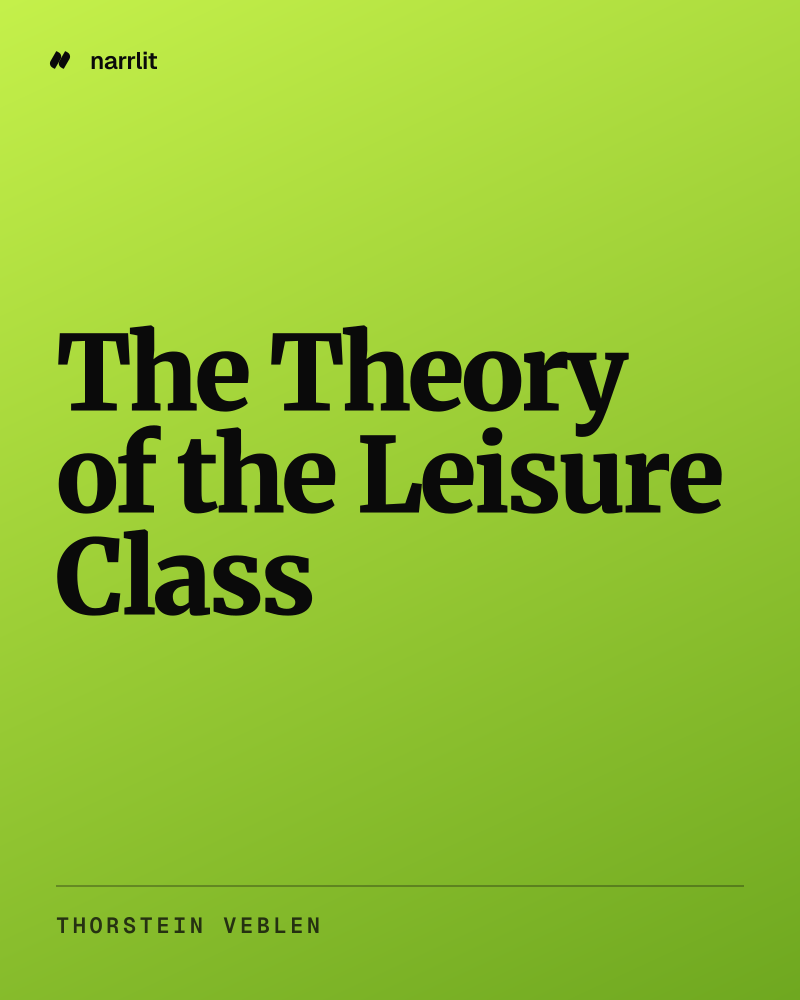
Thorstein Veblen · 53min
This sharp critique of social status reveals why humans consume for show rather than need. Veblen dissects the habits of the elite and the heavy cost of prestige. We invite you to explore the mechanics of vanity.
“We selected The Theory of the Leisure Class by Thorstein Veblen to explore its lasting influence on the evolution of philosophy. It provides a perfect canvas for debating the complex motives of its characters.”
Get this book free
Sign up and your first token is on us, use it to unlock permanently.
Thorstein Veblen’s 1899 treatise provides a sociological x-ray of human motivation, arguing that modern economic behavior is driven not by rational utility but by archaic predatory instincts. He structures the book as an evolutionary history, beginning with peaceable savages who prioritize group flourishing and the instinct of workmanship. This baseline shifts during the barbarian stage, where a predatory animus emerges. Here, human value is recalculated based on exploit—violent, aggressive acts of dominance—rather than productive industry, which becomes culturally branded as base or ceremonially unclean.
As society settles into the quasi-peaceable feudal and industrial eras, this predatory drive mutates. Direct violence is replaced by pecuniary emulation, the endless effort to surpass others in visible wealth. Veblen introduces conspicuous leisure as a primary status marker; the elite must visibly abstain from work to prove their power. This performance requires immaterial goods, such as the mastery of dead languages or complex etiquette, which serve as receipts for wasted time. In dense, anonymous cities, this evolves into conspicuous consumption, where status is signaled through expensive, impractical goods like hand-wrought silver spoons or canine monstrosities like the English Bulldog.
The narrative concludes by examining the conflict between status-seeking waste and the instinct of workmanship. Veblen identifies the New Woman movement of his time as a reversion to the peaceable stage, where individuals reject the role of ceremonial consumer to seek genuine utility. He positions the leisure class as a conservative anchor that stalls social evolution by insulating itself from economic pressure and forcing the middle class to exhaust its energy in imitation. Ultimately, Veblen presents a society trapped in a cycle of expensive ugliness, where the desire for prestige perpetually overrides the rational need for comfort.
Thorstein Veblen, an American economist and sociologist, published The Theory of the Leisure Class in 1899 during the height of the Gilded Age. This period was characterized by extreme wealth inequality, the rise of industrial tycoons, and flamboyant displays of riches in American cities. Veblen wrote the text while teaching at the University of Chicago, reacting to the rigid social hierarchies and the robber baron culture that dominated the era. Unlike his contemporaries who viewed economic actors as purely rational, Veblen drew on evolutionary biology and anthropology to explain social behavior. His work challenged the foundations of classical economics by suggesting that consumption is a psychological weapon used to establish rank rather than a simple means of satisfying physical needs. By situating modern habits within a barbarian framework, he provided a sharp critique of the waste inherent in capitalist social structures, influencing the Progressive movement and future sociological thought.
The driving force of society is the desire to match or exceed the wealth of one's neighbors to avoid social stigma. Veblen argues that because the goal is relative ranking rather than physical comfort, the treadmill of accumulation is infinite. For example, a person may feel a surge of satisfaction upon buying a luxury car, but that feeling evaporates as soon as the vehicle becomes the new community baseline, triggering a chronic dissatisfaction that fuels further waste.
Value is often attributed to objects or activities specifically because they represent a useless expenditure of time or resources. Veblen calls this honorific costliness. He cites the example of the hand-wrought silver spoon; its aesthetic value stems from tiny imperfections, which serve as proof of the expensive, manual labor required to create it. If a machine-made spoon were visually identical and more functional, it would still be deemed vulgar because it lacks the required mark of waste.
Beneath layers of status-seeking lies a fundamental human drive to be useful and to create things of value. This instinct is the primary antagonist to predatory culture. Veblen sees this operating in the New Woman movement of the late nineteenth century. These women sought to escape the role of being ceremonial consumers for their husbands, attempting instead to return to the productive, purposeful labor that characterized the earliest stages of human socialization before the predatory stage hijacked human value.
Moments from Jasper and Maya's discussion of The Theory of the Leisure Class:
“The predatory instinct never actually disappeared. It just learned how to dress better.”
— Maya
“The objective is to excel everyone else in the visible accumulation of goods.”
— Maya
“Productive labor becomes, in Vablen's incredibly potent phrasing, ceremonially unclean.”
— Maya
“We actually allow the economic reality of waste to fundamentally reshape our visual preference.”
— Maya
“The intense societal requirement to look decent absorbs all the kinetic energy that could have been utilized for actual human progress.”
— Jasper
“The more refined, polite and delicate a society appears on the surface, the more it is actually participating in a ruthless, archaic display of domination.”
— Maya
It is a sociological critique of the ways in which social status and prestige drive human economic behavior. Thorstein Veblen argues that the elite leisure class signals its power through conspicuous consumption and the visible waste of time and resources. The book explores how these archaic, predatory instincts persist in modern industrial society.
The book was written by Thorstein Veblen, an influential American sociologist and economist. It was originally published in 1899 during the Gilded Age, a time of immense industrial expansion and growing wealth inequality in the United States.
Yes, the book is in the public domain because it was first published in 1899. Readers can legally access the full text for free through various digital archives and open-access websites.
The narrlit episode discussing Thorstein Veblen's work is 53 minutes long. Hosts Jasper and Maya use this time to analyze the book's evolutionary theories and their relevance to modern consumer psychology.