 narrlitnarrlit
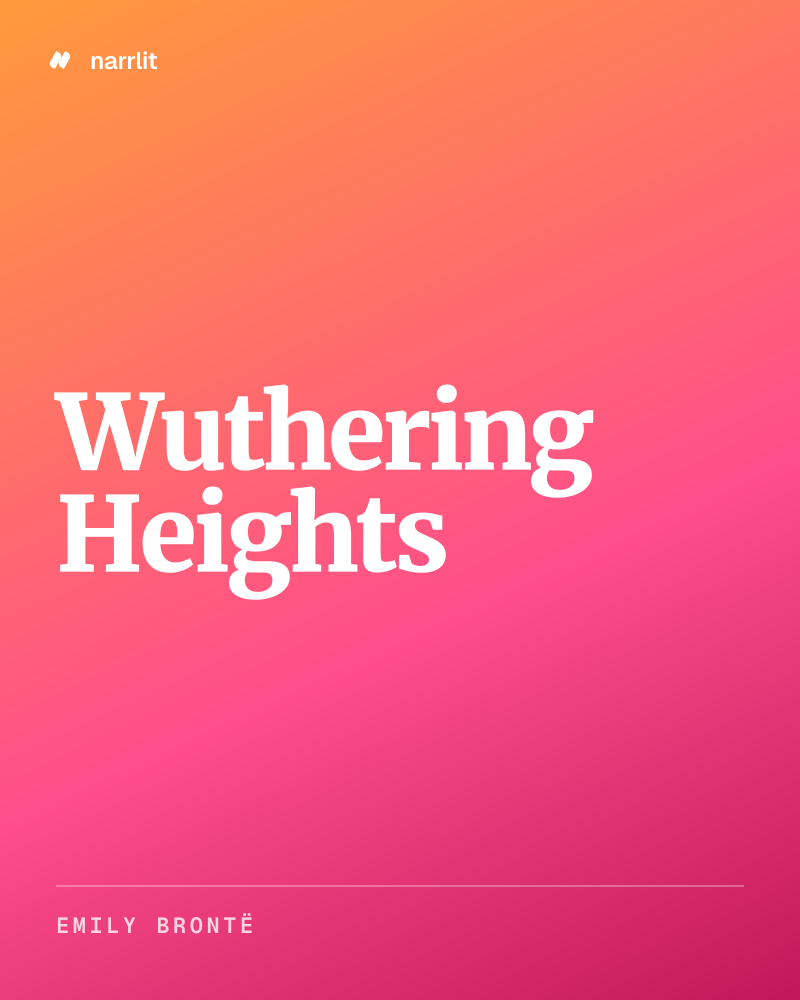
Emily Brontë · 45min
Enter the desolate world of Wuthering Heights. Tenant Lockwood encounters the enigmatic Mr. Heathcliff, whose brooding presence and the wild Yorkshire moors set a tone of intense passion and Gothic mystery. Dive into this classic tale of forbidden love and revenge.
“We selected Wuthering Heights by Emily Brontë to explore its lasting influence on the evolution of romance. It provides a perfect canvas for debating the complex motives of its characters.”
Get this book free
Sign up and your first token is on us, use it to unlock permanently.
The novel begins in 1801 as Lockwood, a tenant at Thrushcross Grange, visits his landlord Heathcliff at the remote Wuthering Heights. During a snowstorm, Lockwood stays the night and experiences a terrifying encounter with the ghost of Catherine Linton. Returning home, he asks his housekeeper, Nelly Dean, to recount the history of the house. Nelly explains that Mr. Earnshaw brought home an orphan, Heathcliff, who formed a profound bond with Earnshaw's daughter, Catherine. However, Catherine’s brother, Hindley, subjected Heathcliff to systemic abuse and class degradation. Catherine, though identifying her soul with Heathcliff, chose to marry the refined Edgar Linton to secure social standing.
Devastated by Catherine’s rejection, Heathcliff vanished for three years and returned as a wealthy gentleman driven by a desire for revenge. He methodically dismantled the lives of those who wronged him. He fed Hindley’s gambling addiction to seize Wuthering Heights and manipulated Edgar’s sister, Isabella, into a miserable marriage to hurt the Linton family. Catherine died in childbirth after a violent final confrontation with Heathcliff, leaving him in a state of perpetual agony and obsession. He spent the next eighteen years haunting the moors and tormenting the next generation: Catherine’s daughter, Hindley’s son Hareton, and his own sickly son Linton.
Heathcliff successfully secured both estates by forcing a marriage between young Cathy and the dying Linton. However, his victory proved hollow as he began to see visions of the elder Catherine in the faces of the children. Eventually, Heathcliff lost the will to continue his cruelty and starved himself to death to join her in the spirit world. The cycle of trauma is finally broken when Cathy and Hareton fall in love through mutual empathy and education. The novel concludes with the two estates unified in peace while local lore suggests the ghosts of Heathcliff and Catherine wander the moors together.
Emily Brontë published Wuthering Heights in 1847 under the pseudonym Ellis Bell. As the middle child of the famous Brontë sisters, she lived a reclusive life in Haworth, Yorkshire, where the wild and isolated moors served as the physical and emotional foundation of her narrative. This historical context is vital, as the novel draws from both Gothic tradition and Romanticism, prioritizing raw psychological depth over the polite societal norms of the mid-Victorian era. Unlike the domestic fiction of her contemporaries, Brontë’s work was controversial upon its release due to its graphic depictions of cruelty and the amoral nature of its protagonists. It challenged the period's expectations of the civilized novel by presenting a world where human instinct and obsession frequently override social contracts and religious morality. Today, the book is recognized for its unique structure of nested narrators and its uncompromising look at the destructive potential of passion.
Brontë explores how Victorian class structures act as a destructive force. Heathcliff’s status as an unknown quantity without a pedigree makes him an outcast. Catherine explicitly states it would degrade her to marry him because Hindley has lowered him to the level of a common laborer. This rejection drives Heathcliff to leave and return as a gentleman by appearance, using his acquired wealth and knowledge of property law to dismantle the families that once looked down on him.
The novel functions as a study of how the sins of parents are visited upon their children. Hindley’s physical abuse of Heathcliff is mirrored in the second half of the book when Heathcliff treats Hindley’s son, Hareton, as a common farmhand. Heathcliff admits he has reconstructed a prison specifically to lock his enemy's heir inside. This cycle only breaks when young Cathy chooses to offer Hareton education and empathy instead of the scorn she was taught to feel.
A central conflict lies in Catherine’s belief that her soulmate connection to Heathcliff transcends reality. She famously claims she is Heathcliff, viewing him as an extension of her own being. However, she attempts to reconcile this with a conventional marriage to Edgar Linton for social stability. This clash between the wild heights and the civilized grange is unsustainable. The tragedy occurs because Catherine cannot exist in the social world while her soul remains tied to the elemental world of Heathcliff.
Moments from Jasper and Maya's discussion of Wuthering Heights:
“The traditional rules of courtship, of society, of even basic human empathy, they simply do not apply here.”
— Jasper
“The supernatural here is physical, it bleeds, it wails in agony.”
— Maya
“Wuthering Heights is not a home. It is a fortress designed to keep the entire world out.”
— Jasper
“She is the voice of conventional morality trying to explain a fundamentally amoral tragedy.”
— Maya
“His revenge hasn't brought him peace, it has only surrounded him with mirrors reflecting his trauma.”
— Jasper
It follows the life of Heathcliff, an orphan who develops a fierce and destructive bond with his foster sister, Catherine Earnshaw. After Catherine marries for social status, Heathcliff spends years enacting a brutal revenge scheme against the two families that wronged him.
The novel was written by Emily Brontë and published in 1847. She originally used the male pseudonym Ellis Bell to avoid the prejudices faced by female authors during the Victorian era.
Yes, the novel is in the public domain because it was published in the mid-19th century and the author has been deceased for more than 70 years. This means the text is free to read, adapt, and share without copyright restrictions.
The discussion of Wuthering Heights by Jasper and Maya is 45 minutes long. The hosts walk through the entire narrative arc, from the arrival of the tenant Lockwood to the final resolution of the generational cycle.